The Most Overlooked Room in Your Flat That Is Not Technically a Room
Every HDB flat with a balcony has the same story. The intention at key collection is to make something of it. A garden corner maybe, or a reading nook, or at least an outdoor dining setup for weekend mornings. Then the renovation begins, the balcony gets deprioritised and two years later it is where the bicycle lives, alongside three boxes you never unpacked and a clothes rack that is easier to leave out there than find another solution for.
The balcony does not have to be that. But making it into something useful requires treating it as a proper design decision during renovation rather than an afterthought.
First: Understand What HDB Allows
Before any design decisions, it is worth knowing what HDB permits for balconies. You may not enclose a balcony with glass panels, solid walls or any structure that permanently changes the external appearance of the building without HDB’s specific approval. This means the balcony must remain visibly a balcony from the exterior. You cannot screen it off completely or turn it into an indoor room.
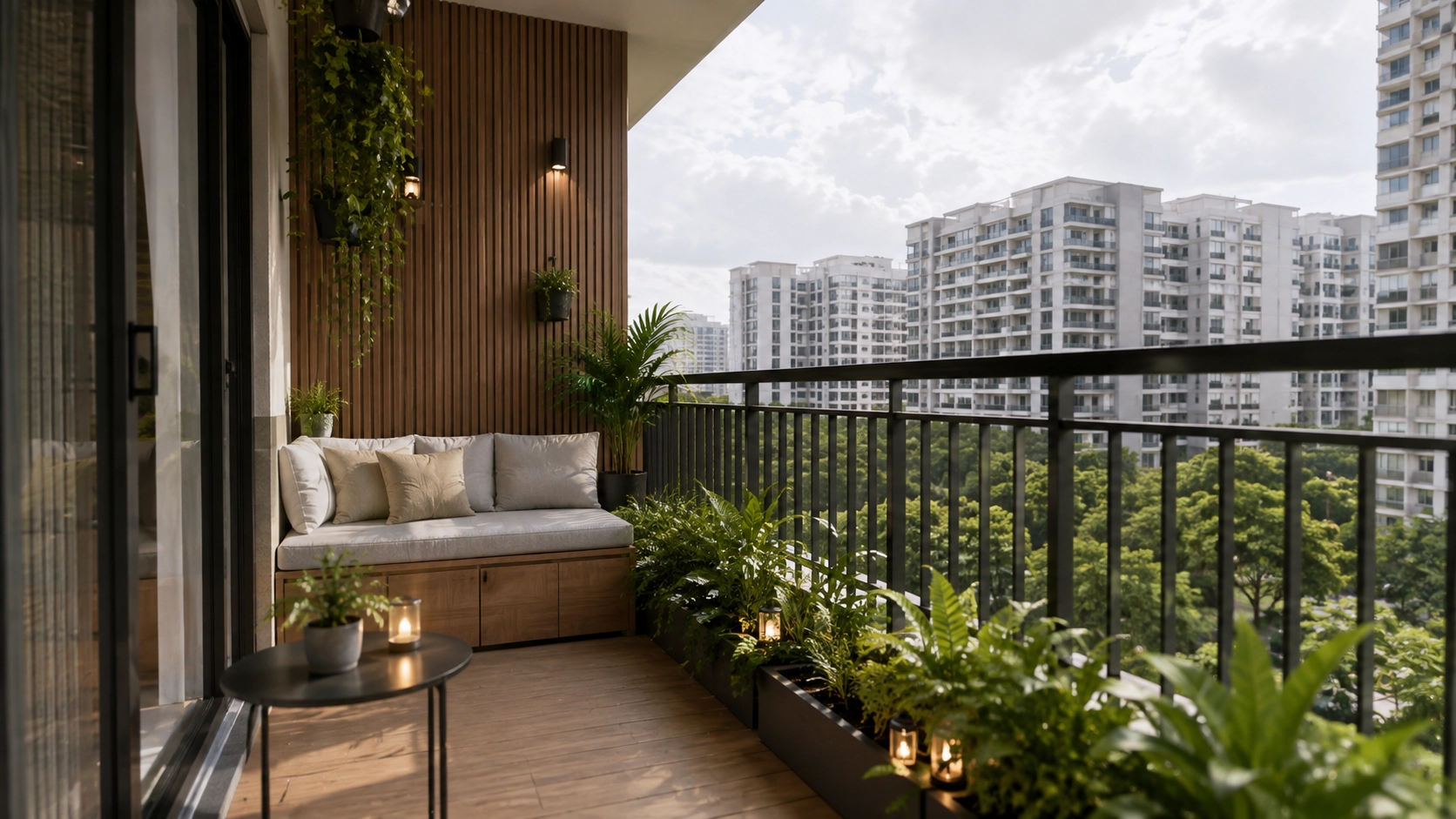
What you can do: lay new flooring over the existing screed, install planters and garden features, add outdoor furniture, install ceiling fans (where the ceiling structure permits), add retractable awnings or shade sails and hang outdoor lighting. These are meaningful improvements that do not require a permit.
Balcony Flooring: The Biggest Visual Change You Can Make
The standard HDB balcony floor is bare concrete screed or basic homogeneous tiles. Replacing this is the single most impactful design change you can make to the space. The options that work well for Singapore’s outdoor conditions:
- Timber decking: Warm, natural and transforms the feel of the space immediately. Real timber requires periodic oiling and sealing to handle Singapore’s humidity and UV exposure. Composite timber decking (engineered wood and plastic composite) handles the conditions better and requires minimal maintenance while looking almost identical.
- Outdoor porcelain tiles: Durable, low maintenance and available in a wide range of finishes including concrete-look and stone-look. Must be rated for outdoor and wet use with an appropriate slip resistance rating.
- Interlocking deck tiles: A lower-commitment option that sits on top of the existing surface without adhesive. Removable and replaceable. Works well if you are not ready to commit to a permanent flooring change.
Plants: The Quickest Way to Make a Balcony Feel Alive
Singapore’s climate is one of the best in the world for balcony gardening. The combination of year-round warmth, high humidity and abundant light means plants grow with very little encouragement. A balcony with well-chosen plants feels immediately more alive and more personal than any amount of furniture can achieve on its own.
For Singapore balconies, the plants that perform best without requiring specialist care are heliconias and gingers (for a lush tropical feel), succulents and cacti (full sun positions, minimal watering), pothos and philodendrons (shadier positions, fast growing, low maintenance) and herbs like lemongrass, pandan and Thai basil, which are genuinely useful in a Singapore kitchen and thrive in outdoor conditions.
Vertical planting is worth considering for small balconies. A wall-mounted planter system can give you significant greenery without using floor space. This pairs well with the biophilic design principles we discuss in our biophilic interior design guide.
Furniture: Scale Is Everything on a Small Balcony
The most common balcony furniture mistake in Singapore HDB flats is oversizing. A two-seat outdoor sofa that looks compact in the store takes up three-quarters of the balcony floor space and then the balcony just becomes an outdoor living room without the indoor part’s comfort.
For a standard HDB balcony of 4 to 8 sqm, the best furniture choices are bistro-scale. A small round table of 60 to 70cm diameter with two folding or stackable chairs is enough for a morning coffee setup and takes up minimal space when not in use. Fold-down wall-mounted tables are even better for very small balconies as they collapse flat against the wall when not needed.
Wall-mounted options and hanging chairs (the egg chair style that suspends from the ceiling) work well specifically because they keep floor space clear, making the balcony feel larger than it is.
Lighting for Evening Use
A balcony with no lighting is a balcony you only use during daylight hours, which in Singapore means roughly 7am to 7pm. Adding outdoor lighting extends the useful hours significantly and transforms the atmosphere from a daytime utility space to an evening destination.
String lights are the easiest option and can be attached to the railings or stretched between wall points without any electrical work. For a more permanent and polished result, a ceiling-mounted outdoor light with a moisture-rated fitting and a cable run from the internal electrical circuit gives you a proper lighting point that works in the rain. This is something to plan with your electrician during renovation rather than retroactively.
If you are in the midst of planning your renovation and want to think through the balcony properly as part of the whole project, talk to us. Browse our completed project gallery for HDB renovations that include outdoor spaces done well.